
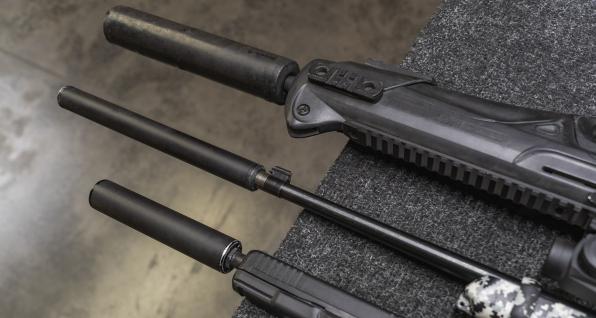
BFA urges passage of SB 214 to remove suppressors from ordnance definition
Now that a federal judge in Texas on Aug. 5 has ruled that the remaining required registration of short-barreled rifles and suppressors in the National Firearms Act (NFA) is unconstitutional without a monetary tax, it's up to the Ohio House of Representatives to pass Senate Bill 214 to remove suppressors from the list of dangerous ordnances in Ohio law.
The bill, sponsored by Sen. Kyle Koehler (R-Springfield) and backed by Buckeye Firearms Association, proposes revisions to the Ohio Revised Code, eliminating suppressors and mufflers from the definition of dangerous ordnance and removing language that mandates suppressor registration under the NFA.
The Senate passed the bill in March, and the Ohio House leadership has assured BFA that the bill would be passed as soon as it reconvenes from summer recess.
BFA has testified multiple times in favor of SB 214, most recently June 9 before the House Public Safety Committee.
From the testimony of Jim Samuel, BFA's legislative affairs director:
Anyone who shoots or hunts frequently has likely experienced some degree of hearing loss. And noise complaints frequently plague outdoor ranges. This is why suppressors can be a useful tool to promote hearing safety and reduce noise pollution. ... Senate Bill 214 is a straightforward yet important piece of legislation that simply removes suppressors and mufflers from a list of dangerous ordinances in the code … . It seeks to treat suppressors as the safety accessory they are.
Sean Maloney, BFA's legal counsel, wrote an article for AmmoLand, titled Ohio’s Unfinished Suppressor Reform Leaves a State-Law Trap for Gun Owners, describing the need to pass SB 214, pointing to a ruling in a similar case, Silencer Shop Foundation v. ATF.
Maloney wrote, in part:
For years, Second Amendment advocates have pointed to an incongruity in Ohio law: a firearm suppressor is classified as “dangerous ordnance.” Ohio Revised Code § 2923.11(K)(5) expressly includes “[a]ny firearm muffler or suppressor” in that definition. The same definition that separately includes explosives, grenades, mines, rocket launchers, and other military-type weapons. A suppressor is not itself statutorily classified as an explosive, but Ohio’s dangerous-ordnance framework nonetheless places it in a legal category far removed from an ordinary firearm accessory.
That classification has serious consequences. Under R.C. 2923.17(A), a person generally may not knowingly acquire, have, carry, or use dangerous ordnance. A violation is a felony of the fifth degree. R.C. 2923.17(D).
For ordinary civilian suppressor owners, the principal statutory protection is found in R.C. 2923.17(C)(5): the exemption for owners of dangerous ordnance registered in the National Firearms Registration and Transfer Record under 26 U.S.C. § 5841. Ohio also provides a separate, limited hunting-related provision through R.C. 2923.17(C)(8) and R.C. 1533.04. But for the ordinary owner outside those narrow circumstances, Ohio law ties lawful possession to federal NFA registration. …
Until the House acts and the legislation becomes law, Ohio suppressor owners remain subject to a statutory structure that turns federal registration status into the central protection against a state felony charge. That is a problem Ohio lawmakers can and should fix (and) not leave Ohio gun owners one federal policy change away from a state-law felony trap.
Dean Rieck, BFA's executive director, said it is imperative that the House pass SB 214 without delay.
"This bill has strong bipartisan support," Rieck said. "In March, it passed the Senate committee 5-0 and the full Senate 31-1, which is rare for a firearms-related bill in Ohio. When there's that level of agreement about legislation, a bill should move swiftly."
BFA joined a lawsuit filed in February 2026, Roberts v. ATF, and asked the courts in April to strike down NFA rules on suppressors and short-barreled rifles and shotguns.
As BFA noted when the case was filed, until the passage of President Donald Trump's One Big Beautiful Bill, the NFA had imposed a $200 excise tax ("tax stamp") on suppressors and on short-barreled rifles and required a tax-enforcement registration requirement on those items.
Trump's bill included both the SHORT Act and the Hearing Protection Act and would have eliminated the NFA tax and registration. At the time, BFA joined a long list of organizations nationwide in signing an open letter to two U.S. House of Representatives committees, insisting that Congress eliminate unjust restrictions imposed by the NFA.
The Supreme Court has established that any regulation on arms-bearing conduct must be consistent with our nation’s historical tradition of firearm regulation. As the complaint argues, there is no tradition that supports the NFA’s registration requirement for protected arms such as suppressors and short-barreled rifles.
BFA maintains a list of gun-related bills in the current state legislative session, including where we stand on them. See our Legislation page.
Joe D. "Buck" Ruth, a pen name for Scott Hummel, is a longtime small-game hunter and gun owner who spent nearly three decades in the news industry. He is the website and social-media manager for Buckeye Firearms Association.
- 3566 reads