

Lott paper: Australians dramatically more likely than Americans to be victims of violent crime
John Lott, PhD, and Crime Prevention Research Center senior fellow Kesten Green, who is also a researcher at the Adelaide University, College of Business and Law, compared the violent crime rates in Australia and the United States. Australian are clearly at much greater risk of violent crime than Americans.
So why not let Australians protect themselves?
We have previously written on the impact of the 1996/97 confiscation in Australia on homicide and suicide rates.
The U.S. experienced a serious violent crime increase of 59% during the Biden administration. Despite that increase, Americans remained safer from violent crime than Australians. Yes, you did just read that — Australians are more likely to be victims of violent crime than Americans. Much more, in fact.
BFA news: Jim Samuel joins BFA as new Legislative Affairs Director
In the most recent comparable years, the surveyed U.S. violent victimization rate was 23.3 per 1,000, while Australia’s was 39 per 1,000 respondents who were victims of “one or more selected personal crimes.” Due to measurement differences, Australia’s 67% higher victimization rate understates the crime victimization of Australians relative to American.
We note that U.S. citizens have far greater and easier access to firearms for self-defense and defense of others than do Australians and that legislation, regulation, and enforcement in the U.S. are much more supportive of defensive use of firearms than in Australia. There are more than 1.6 million defensive gun uses each year in the U.S., almost 21 million holders of permits to carry a concealed handgun, and in 29 of the 50 U.S. states, a permit is not needed.
In this short review of the statistics, we emphasise total per capita violent crime estimates from crime victimization surveys, rather than from the subset of violent crime that was reported to the police. (Reporting of crime is low in both countries, with reporting rates under 60% for all categories.) For the U.S., the figures are from the Bureau of Justice Criminal Victimization report for 2024 (NCVS) and, for Australia, from the Australian Bureau of Statistics Crime Victimization report for the 2023-24 financial year (ABS).
The U.S. crime victimization survey includes 240,000 respondents and the Australian 26,176, which represent broadly similar proportions of the respective countries’ total populations. The U.S. and Australian national surveys are related to the International Crime Victimization Survey (ICVS), which was last conducted in full in 2005. The surveys capture 12-month periods and capture both crimes that were reported to the police, and those that were not.
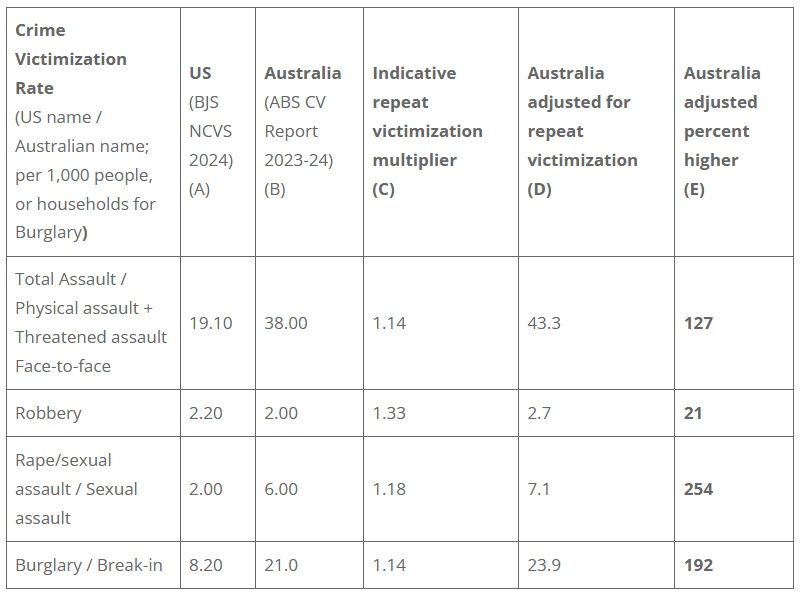
Comparisons between the U.S. and Australian victimization rates for key violent crime categories are summarised in the table, below (or view as image at bottom of story).
| Crime Victimization Rate (US name / Australian name; per 1,000 people, or households for Burglary) |
United States (BJS NCVS 2024) (Col. A) |
Australia (ABS CV Report 2023-24) (Col. B) |
Indicative repeat victimization multiplier (Col. C) |
Australia adjusted for repeat victimization (Col. D) |
Australia adjusted percentage higher (Col. E) |
| Total Assault / Physical assault + Threatened assault Face-to-face | 19.10 | 38.00 | 1.14 | 43.30 | 127 |
| Robbery | 2.20 | 2.00 | 1.33 | 2.70 | 21 |
| Rape/sexual assault / Sexual assault | 2.00 | 6.00 | 1.18 | 7.10 | 254 |
| Burglary / Break-ins | 8.20 | 21.00 | 1.14 | 23.90 | 192 |
There is an important difference between the surveys: The Australia data is the proportion of people or of households that have been victimized by crime at least once during the year, whereas the U.S. data are based on counts of crimes. That is, when an Australian is robbed twice in one year, only one victimization is reported in the ABS statistics. In the U.S.' NCVS, that would count as two victimizations. The figures in Column C in the table below are indicative repeat victimization multipliers estimated from data presented in a 2015 Center for Problem-Oriented Policing Conference report “Analyzing Repeat Victimization” and are used to calculate the figures in Column D for comparisons with the US figures in Column A.
The age bases of the figures also differ, with the U.S.' NCVS, including victims ages 12 years and older, while the ABS figures are for victims ages 15 and older and, in the case of sexual assault, 18 and older. Australia’s physical assault figures may include more minor incidents.
The dramatically higher rates of violent crime victimization in Australia shown in the table above are consistent with the findings of the International Crime Victimization Survey, last completed in 2005, that ensured the same definitions were used and questions asked across countries. And the same age range was also covered.
Read the full report at crimeresearch.org/2026/01/australians-are-dramatically-more-likely-to-be-victims-of-violent-crime-than-americans.
Republished with permission from Crime Prevention Research Center. Sign up for CPRC's newsletters at crimepreventionresearchcenter.nationbuilder.com.
- 723 reads