
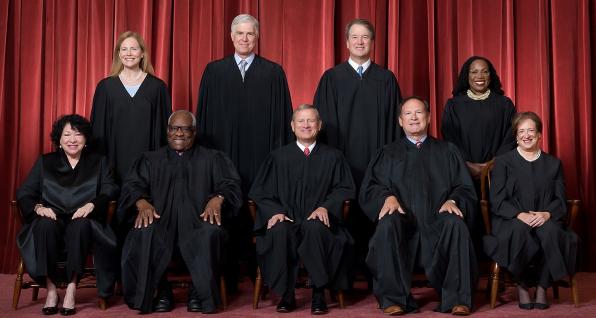
US Supreme Court rejects gun ban imposed on marijuana user
The U.S. Supreme Court just handed gun owners a significant Second Amendment win in United States v. Hemani, and it did so by rejecting one of the federal government’s favorite tricks: turning a broad status label into a lifetime gun ban.
On June 18, 2026, with a unanimous 9-0 decision, the court affirmed the Fifth Circuit and held that the government’s prosecution of Ali Danial Hemani under 18 U.S.C. 922(g)(3)’s “unlawful user” provision was inconsistent with the Second Amendment. That statute bars firearm possession by anyone who is an “unlawful user” of or “addicted to” a controlled substance.
According to Justice Neil Gorsuch’s majority opinion, the government relied on Hemani’s admitted marijuana use “about every other day” and his possession of a firearm in his home. That was enough, the government claimed, to prosecute him, threaten him with up to 15 years in federal prison, and disarm him for life. The Supreme Court said no.
Related article from July 2025: Eighth Circuit tosses gun conviction on marijuana user, orders retrial
The court told the federal government that it cannot erase a citizen’s Second Amendment rights with a status label unless it can meet its burden under Bruen and Rahimi.
The government admitted that § 922(g)(3) burdens conduct protected by the Second Amendment. Once the plain text of the Second Amendment is implicated, the burden shifts to the government to prove that its restriction is consistent with the nation’s historical tradition of firearm regulation.
The government tried to carry that burden by comparing marijuana users to historical “habitual drunkards.” But the analogy collapsed.
Justice Gorsuch wrote that the government’s version of § 922(g)(3) automatically bans a person from possessing a gun once he becomes an unlawful user of any controlled substance, regardless of the drug, amount, effect, reason for keeping the gun, or whether the person has ever been dangerous. That is not a modest safety regulation. That is automatic disarmament.
The majority explained that historical “habitual drunkard” laws did not target people merely because they regularly consumed alcohol. A regular drinker was not the same thing as a person so intoxicated that he could not manage his own affairs. The opinion noted that early American laws often focused on people whose drinking rendered them incapacitated, mentally incompetent, or unable to conduct their affairs. Hemani, slip op. at 8–10.
The Founding generation lived in what the court called a “culture of copious drinking,” yet the government could not show a historical tradition of disarming ordinary people simply because they used an intoxicant.
As Justice Alito noted in his concurring opinion, “marijuana use today is like alcohol use at the founding. It is widespread and increasingly considered socially acceptable in many quarters. And from a practical standpoint, law enforcement widely tolerates the use of marijuana.”
The majority also rejected the government’s claim that old vagrancy, commitment, and surety laws were close enough analogues because they supposedly targeted dangerous people. The court found that those laws often had very different purposes: promoting productivity, protecting families from financial ruin, or enforcing public morals. They were not broad, automatic firearm bans on people the government simply labeled dangerous.
Then came another major problem for the government: process. Historical laws usually required some proceeding before a person lost liberty. By contrast, under the government’s reading of § 922(g)(3), a person automatically loses the right to keep and bear arms the moment he becomes an unlawful user, with no pre-deprivation process at all.
The court also took direct aim at the government’s dangerousness argument. Section 922(g)(3) borrows from the Controlled Substances Act, a law aimed at health and general welfare, not a firearm-specific judgment about violence. The court noted that drugs can be scheduled for reasons having little to do with violent misuse of firearms.
That is the hole in the government’s case. Washington wanted the power to say: “We put this substance on a list, you used it, therefore you are too dangerous to own a gun.” The Supreme Court was not willing to hand the government that kind of blank check.
The majority warned that giving the government “broad power to designate any group as dangerous and thereby disqualify its members from having a gun” would risk allowing it to “quickly swallow” the Second Amendment.
The ruling is narrow, and gun owners should understand the limits. The court said it was not deciding bans on addicts, people presently intoxicated while possessing firearms, felon-in-possession laws, or a future prosecution where the government offers individualized proof that a defendant’s drug use made him dangerous.
But narrow does not mean meaningless. Hemani is a direct rejection of automatic status-based disarmament without historical support and without proof that the citizen actually poses a danger. That is a big deal, especially in a country where marijuana remains illegal under federal law while many states have legalized it in some form.
Justice Clarence Thomas added another warning shot in concurrence. He agreed with the Second Amendment ruling but wrote separately to question whether § 922(g), as commonly applied, exceeds Congress’s Commerce Clause power. Thomas criticized the idea that the federal government can regulate simple intrastate gun possession merely because a firearm once crossed state lines.
That concurrence may become very important in future Second Amendment litigation. For decades, the federal government has used the “interstate commerce” hook to turn ordinary local gun possession into a federal crime. Thomas is openly inviting courts to revisit that theory.
The 9-0 judgment, with Justice Elena Kagan joining Justice Samuel Alito’s concurrence, shows just how far the federal government overreached in trying to turn marijuana use into automatic disarmament.
For gun owners, the takeaway is simple: the Second Amendment is not a second-class right, and the government does not get to cancel it by labeling broad categories of people as presumptively dangerous.
Hemani does not end every fight over § 922(g)(3). It does not settle every marijuana-and-guns question. But it does put the federal government on notice that the days of lazy analogies, broad labels, and automatic disarmament are numbered.
- 304 reads